
China criticised the forthcoming meeting of the Foreign Ministers of India, Australia, Japan and the United States in Tokyo, saying it is opposed to the formation of "exclusive clique" harming third party's interests.

The government has asked Chinese mobile companies to increase their exports from India and there is no proposal to ban the sale of handsets below Rs 12,000 made by such firms, Union Minister Rajeev Chandrasekhar said on Monday. The Minister of State for Electronics and IT also said that Indian companies also have a role to play in the country's electronic ecosystem but it does not mean exclusion of foreign brands. "Only issue that we have raised and done very transparently with some of the Chinese brands is that we have said that our expectation is that they will do more exports.

"The fight against impunity is critical to the larger pursuit of securing peace and justice. The Security Council must send an unambiguous and unequivocal message on this count," External Affairs Minister S Jaishankar told the 15-nation UN Security Council briefing on Ukraine 'Fight against impunity'.

The opinion piece added that the party combines the most striking principles of three major political entities in the world -- the Likud Party of Israel, the Communist Party of China and the Muslim Brotherhood of Egypt.

The Chinese company has also collected the data base of bureaucrats in key positions, judges, scientists, academicians, journalists, actors, sportspersons, religious figures and activists, he added.

However, there is no official word on whether there will be any interaction between Modi and Pakistan President Mamnoon Hussain, who is scheduled to attend the meeting in China.

China also welcomed the recent statement made by External Affairs Minister Pranab Mukherjee in Bangkok.
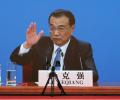
Chinese Premier Li Keqiang, who is at the helm of managing the country's economy for a decade, said that he will be stepping down this year, setting in motion the once-in-a-decade sweeping leadership change in the Communist country.

The forth coming summit of the BRICS leaders in New Delhi would focus on stimulating growth to avert the down turn in global economy besides enhancing financial cooperation among the countries, China said.
India will not allow Chinese companies to participate in highway projects, including those through joint ventures, Union Minister Nitin Gadkari said on Wednesday amid the border standoff with China. Gadakri also said the government will ensure that Chinese investors are not entertained in various sectors like the micro, small and medium enterprises (MSMEs).

In underlining the role of border villages as custodians of India's frontiers, New Delhi is following China's example in Tibet.

The virtual talks took place under the framework of Working Mechanism for Consultation and Coordination on India-China Border Affairs.
Tang Jiaxuan, State Councillor and former Foreign Minister, will hold wide-ranging discussions with Indian officials.
External Affairs Minister Pranab Mukherjee on Wednesday held a bilateral meeting with his Russian counterpart, Sergei Lavrov, more than a week after his visit to Moscow where the two could not meet, triggering reports of a rebuff to the Indian leader. Lavrov requested Mukherjee for a briefing on the latest state of the Indo-US civilian nuclear cooperation deal and he was informed about it.

The maiden Africa India Key Maritime Engagement exercise will be held from April 13 to 18 off the coast of Dar es Salaam, Tanzania.
China has said the dam being built by it on river Brahmaputra will have no impact on the downstream flow of the river into India, External Affairs Minister S M Krishna told the Rajya Sabha on Thursday.
What is it that China seeks and why has the Ladakh border become and remained hot for two years and what is going on in Arunachal Pradesh?, asks Aakar Patel.
Stating this, Chinese Foreign Minister Yang Jiechie added that Hu held bilateral meetings with 12 foreign leaders at the G-8 summit in Germany, which boosted cooperation between nations concerned about international affairs.
Hu, also general secretary of the ruling Communist Party of China, will attend the multilateral meeting of leaders of five developing countries -- India, Brazil, China, Mexico and South Africa on June 8.

China on Friday announced plans to permit the return of 'some' Indian students stranded in India for over two years following the visa and flight restrictions imposed by Beijing due to the COVID-19 pandemic.

Wang Qi, now 77, was caught when he entered the Indian territory shortly after the Sino-India War of 1962. He was later released from jail.

At a media briefing in Beijing, Chinese Foreign Ministry spokesman Wang Wenbin said the two sides have maintained smooth communication on border-related issues through diplomatic and military channels.

The Balochistan Liberation Army (BLA) has undergone a significant transformation, evolving from hit-and-run attacks to carrying out sophisticated operations with tactical precision. The group's tactics and targets have become increasingly audacious, targeting security forces, Chinese nationals, and innocent civilians. Experts attribute the BLA's evolution to various factors, including the leadership of Bashir Zeb, the group's growing intelligence network, and its exploitation of the grievances of the Baloch people. The BLA's actions are a cause for concern, as the group's sophisticated attacks pose a major challenge to security forces.
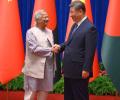
'It was the hostility of the Yunus regime that made India careful and wary of dealing with them.' 'They gradually backed off and lowered the noise, but the damage was done.' 'Their true colours had been exposed.'
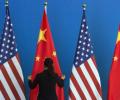
Talks between Chinese Vice Foreign Minister Xie Feng and US Deputy Secretary of State Wendy Sherman to improve the relations got off on a rough note at the northeastern Chinese port city of Tianjin, with Xie launching a blistering attack on Washington, accusing it of being the "owner of coercive diplomacy".

China reiterated that no meaningful dialogue can be held with India until it "unconditionally" withdraws troops from the disputed Doklam area and said Foreign Minister Wang Yi has authoritatively made Beijing's position clear on the issue.
In a commentary entitled 'China's re-emergence should be welcomed' in the state-run China Daily, Lau, a Hong Kong-based politician wrote that for many years China has been trying to resolve conflicts with neighbours through peaceful means.

Prime Minister Narendra Modi and Chinese President Xi Jinping will hold bilateral talks on Wednesday on the margins of the Brazil, Russia, India, China, South Africa (BRICS) summit in Russia, in their first structured meeting since the eastern Ladakh border row erupted in May 2020.
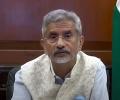
The external affairs minister said the broad principle around which his position would be constructed would be about the importance of maintaining peace and tranquility along the border for the overall development of ties which has been reflected in the last 30 years of the relationship.

He said both sides reaffirmed to sincerely work towards complete disengagement of the troops along the LAC.
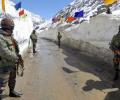
China on Thursday said Chinese and Indian troops have taken "effective measures" to disengage at the Galwan Valley and other areas along the Line of Actual Control in eastern Ladakh and the situation is "stable and improving," days after the two sides agreed on an expeditious withdrawal of soldiers from all the standoff points.
China on Thursday expressed its concern over the activities of the Dalai Lama and his supporters in India but thanked New Delhi for ensuring a smooth run of the Beijing Olympic torch in the Indian capital.The Tibet issue was raised by Chinese Foreign Minister Yang Jiechi, during his talks with External Affairs Minister Pranab Mukherjee, in Beijing.Briefing reporters after the meeting, Foreign Secretary Shivshankar Menon said China 'naturally' raised the issue of Tibet.

Raising the Kashmir issue at the UN, China has told the General Assembly that the "dispute" should be peacefully and properly addressed in accordance with the UN Charter, Security Council resolutions and the bilateral agreement. China, a close ally of Pakistan, also stressed that no actions should be taken that would unilaterally change the "status quo".

'The Chinese thought India would back off. 'They did not expect such a firm Indian response to their expansionist manoeuvre.'

A joint statement was issued by US Secretary of State Tony Blinken, Australian Foreign Minister Penny Wong, and Japanese Foreign Minister Hayashi Yoshimasa after their in-person meeting in Phnom Penh on the margins of the 55th ASEAN Foreign Ministers' Meeting.

Pakistani security forces on Thursday raided the house of the father of the woman suicide bomber from Baloch Liberation Army (BLA) who blew herself up in Karachi University that killed three Chinese teachers and injured another.
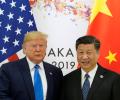
'If you compare the data from 2017 and 2023 of the US imports from the world and China, you will see that the US was a complete loser in the trade war, and China was a complete gainer.'
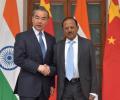
The two sides have already held 21 rounds of talks under the framework of SR dialogue which was set up to find an early solution to the border dispute.
